
Guide
How up and down the river works
Win and move up a court, lose and move down, with a new partner every round. How players move, what happens on the top and bottom courts, more players than courts, and a free app that runs it.
What is up and down the river?
Up and down the river is a doubles format for social play where the courts are ranked: court 1 is the top court. After each game the winners move up a court and the losers move down, so over a session players end up on courts with others of a similar level.
Partners change every round: the pairs split, and the four players on each court make new pairs. Nobody is knocked out, and every court starts the next round together.
Each round depends on the last one's scores, so it can't be planned ahead. Dink Duty, where it's called Up-and-down, builds each round when the scores are in. It needs:
- Doubles. For singles, use a round robin.
- At least 8 players, enough for two courts.
- The score of every game, so keeping score is always on.
How players move between courts
When a round's games are done, Dink Duty moves everyone for the next round:
- Winners move up one court. On court 1, the top court, the winners stay.
- Losers move down one court. On the bottom court the losers stay, unless players are waiting to come on (see More players than courts).
- Nobody moves more than one court a round, so getting from the bottom court to court 1 takes a win on every court on the way up.
- Each court then has a pair from one game and a pair from another, and the four make new pairs.
-
8 players on 2 courts
Everyone plays every round. Court 1's winners stay and its losers go down to court 2. Court 2's winners go up to court 1 and its losers stay.
-
12 players on 3 courts
Everyone plays every round. Court 1 gets its own winners and court 2's. Court 2 gets court 1's losers and court 3's winners. Court 3 gets court 2's losers and its own.
At the end, Dink Duty's final ranking orders players by the court they finished on, then by wins, then by point difference. During the session the standings show who moved up or down since the last round.
How partners change
Every round, the four players on each court split into two new pairs. There are three ways to pair four players, and Dink Duty picks the one that repeats the fewest partners from the last round, then the fewest from the whole session, then the fewest repeat opponents.
So nobody partners the same person two rounds in a row. You keep playing alongside people of a similar level, but with a different partner each time.
How the first round is set
Dink Duty seeds round 1 by Dink Rating: the four highest-rated players start on court 1, the next four on court 2, and so on down. Players without a rating count as the middle of the group.
On each court, the strongest and weakest of the four play the middle two, so the first games are close. With more players than the courts hold, the lowest-rated start in the queue.
If nobody has a rating yet, round 1 is a random draw. On the Dashboard you can set First round to Random instead.
More players than courts
Up-and-down puts four players on each court and uses as many of your courts as it can fill, so 10 players on 3 courts use 2 courts. Everyone else waits in a queue, and whoever has waited longest comes on first.
Players come off from the bottom court: its losers leave the court instead of staying, and the players who have waited longest take their places. For example:
-
9 players on 2 courts
1 waits each round. Of court 2's losers, the one who has played more rounds in a row sits out, and the waiting player comes on. A sit-out lasts 1 round.
-
10 players on 2 courts
2 wait each round. Court 2's losers sit out the next round, and the 2 who were waiting come on. A sit-out lasts 1 round.
-
11 players on 2 courts
3 wait each round. Court 2's losers join the back of the queue, and the 2 who have waited longest come on. A sit-out lasts 1 or 2 rounds.
-
22 players on 4 courts
6 wait each round. Court 4's losers join the back of the queue, and the 2 who have waited longest come on. A sit-out lasts 3 rounds.
Because only the bottom court's losers come off, sit-outs aren't shared out evenly the way a round robin shares them. With many more players than courts, a round robin keeps everyone's number of games closer.
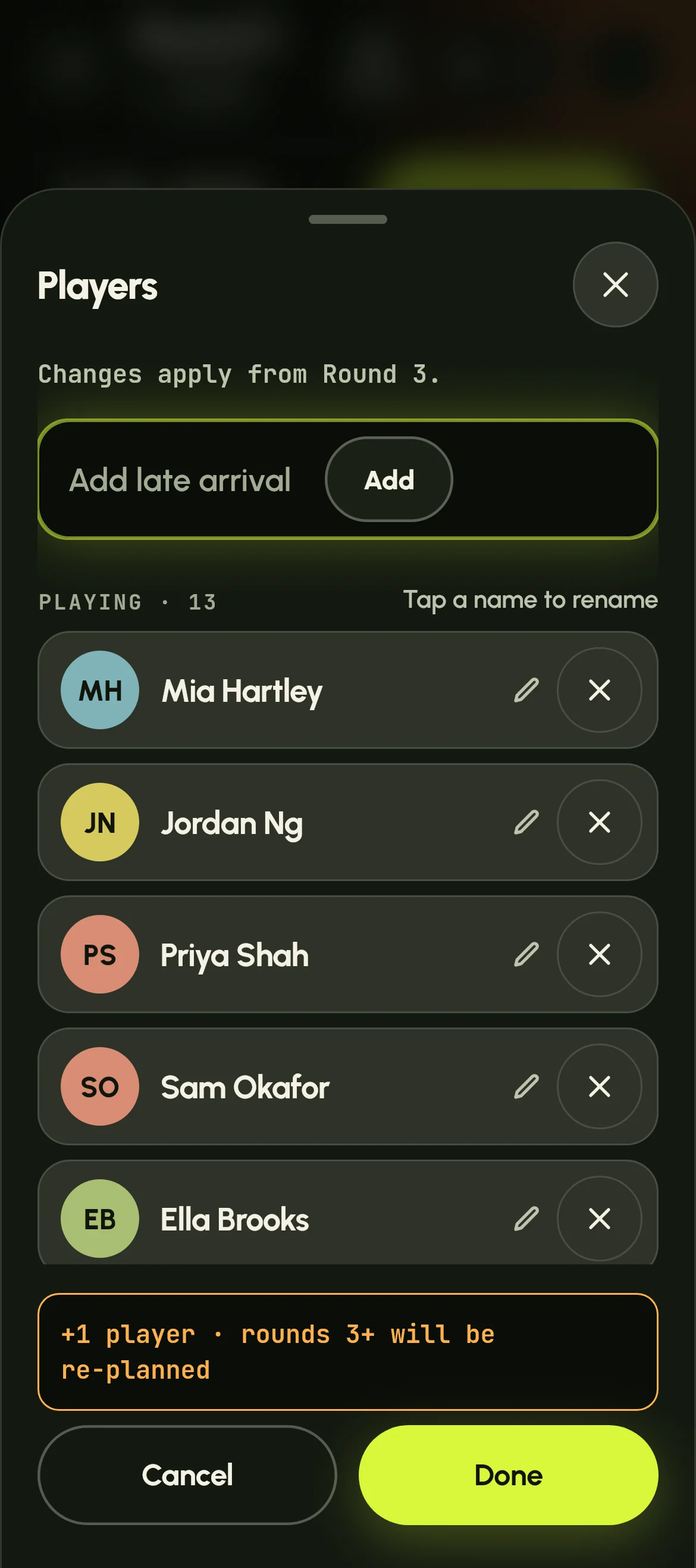
Late arrivals join the back of the queue, and if enough arrive to fill another court, it's added at the bottom. When someone leaves, the next round is rebuilt without them: players are ordered by their court, then wins, then point difference, and the courts are filled from the top.
Level scores and unfinished games
Moving players needs a winner. A game with a level score, such as a timed game that ends level, or with no score at all, has no winner. That court's four players stay on their court for the next round and make new pairs.
The players who would have swapped with them stay on their own courts: the winners below don't come up, and the losers above don't go down. If it's the bottom court, the queue waits a round too.
In the final ranking, a game with no winner counts as neither a win nor a loss.
Up-and-down, round robin or Apex?
Dink Duty runs all three, and each suits a different night:
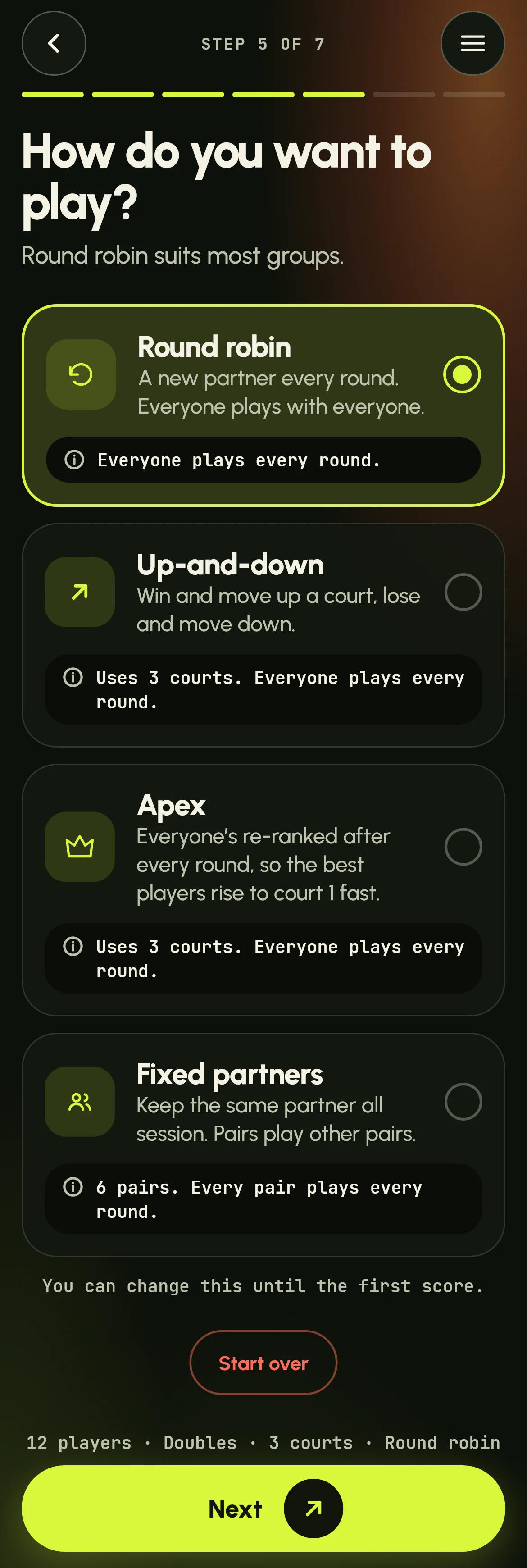
- Up-and-down: win and move up a court, lose and move down. Players settle onto courts of a similar level, one court at a time.
- Round robin: a new partner every round, and everyone plays with everyone. Rounds are planned ahead, scores are optional, and sit-outs are shared evenly. It works for singles too.
- Apex: everyone is re-ranked every round on their whole-night record, so the stonger players rise to court 1 fast instead of one court at a time.
In Dink Duty
How to set up up and down the river in Dink Duty
Dink Duty runs up-and-down on the organiser's phone and moves everyone after each round. Open it at app.dinkduty.com and follow its setup:
-
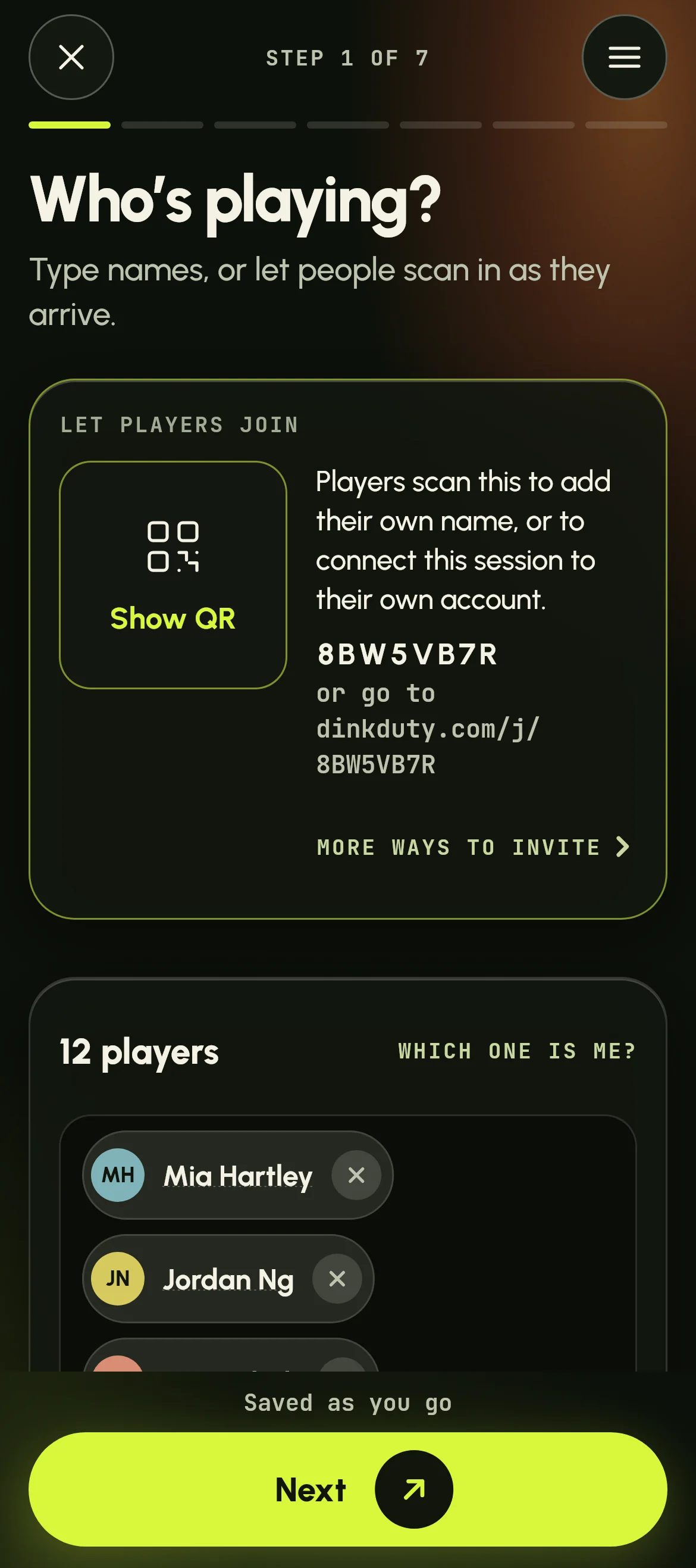
Add players
Type names in or paste a list, or show the QR code so players scan in and add their own. Up-and-down needs at least 8.
-
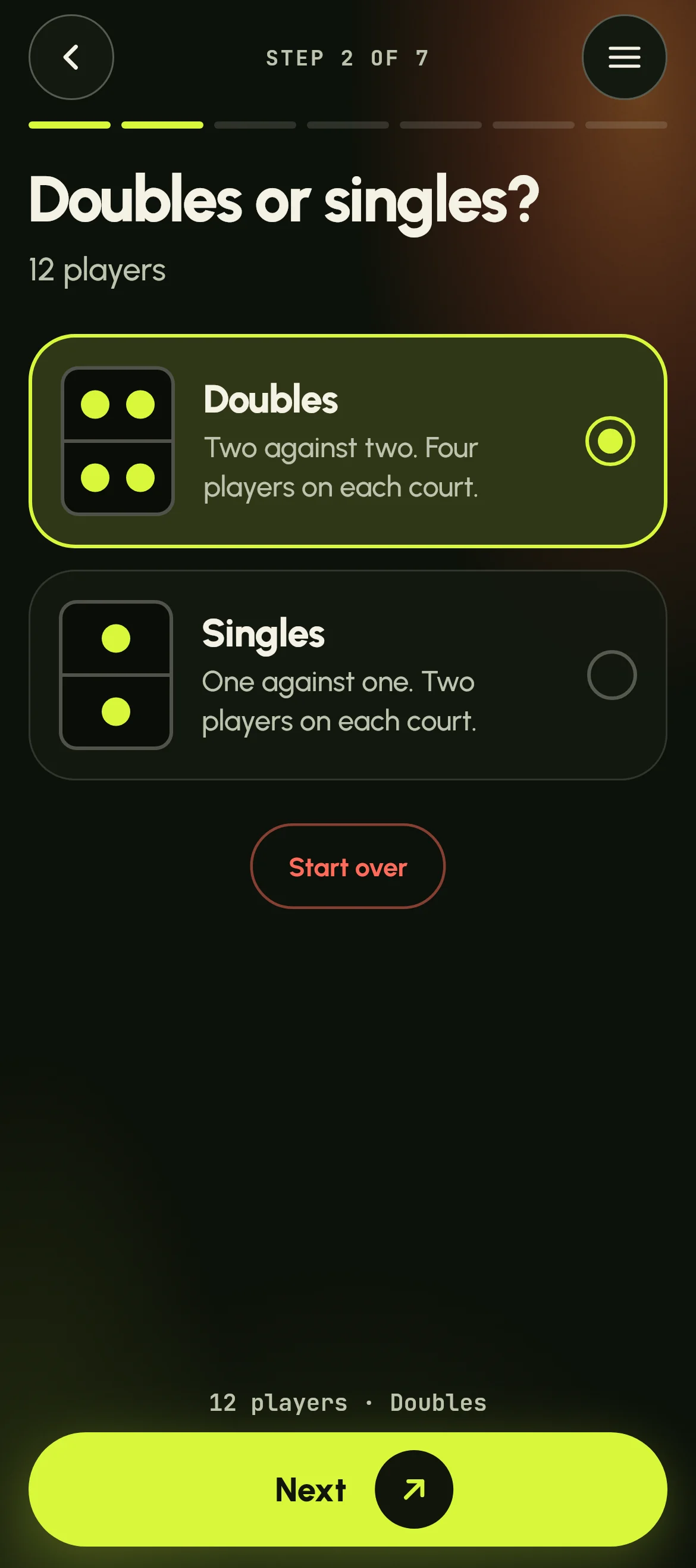
Pick doubles
Up-and-down is doubles only: two against two, four players on each court.
-
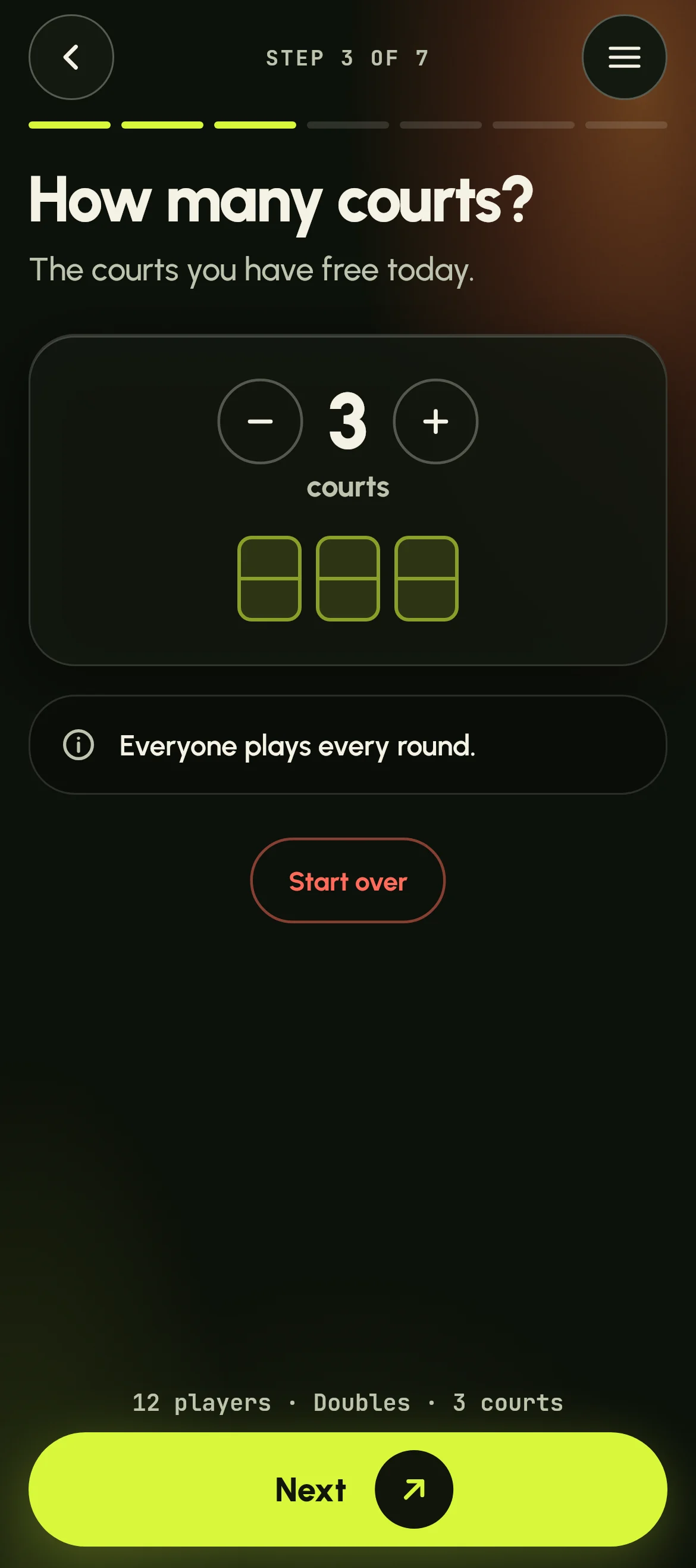
Set your courts
Choose the courts you have free today. Dink Duty shows how many people sit out each round.
-
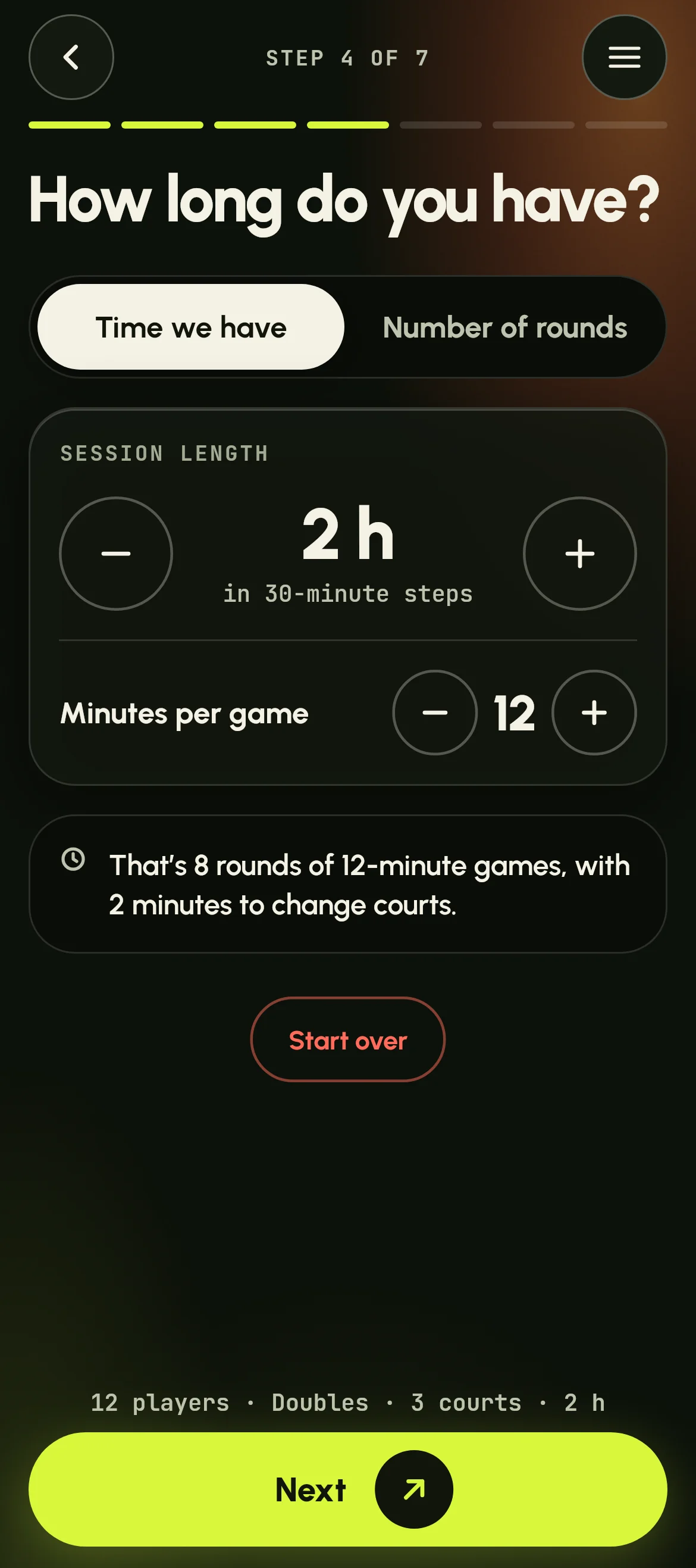
Choose how long
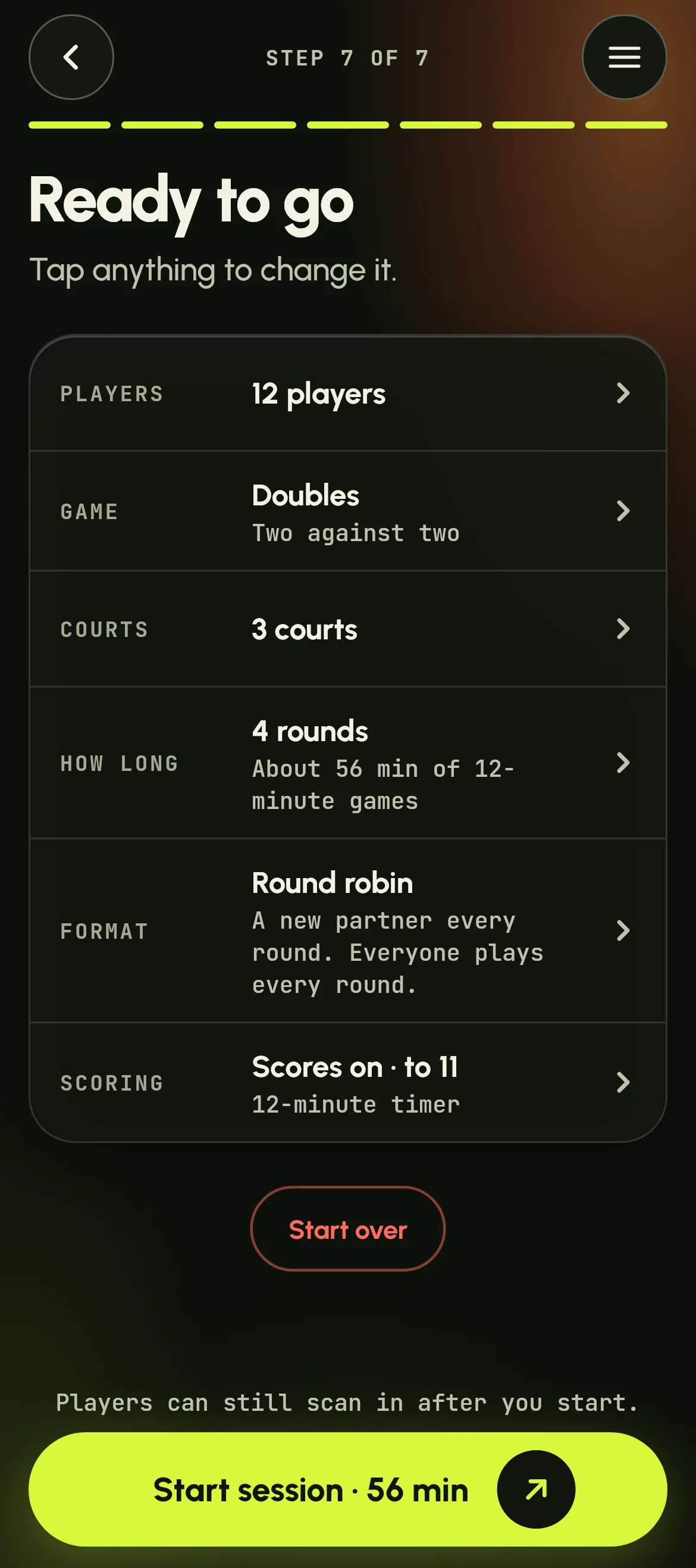
Enter the time you have and the minutes per game, or a number of rounds.
-
Pick Up-and-down
Win and move up a court, lose and move down. Its card shows how many courts it uses and how many people sit out each round.
-
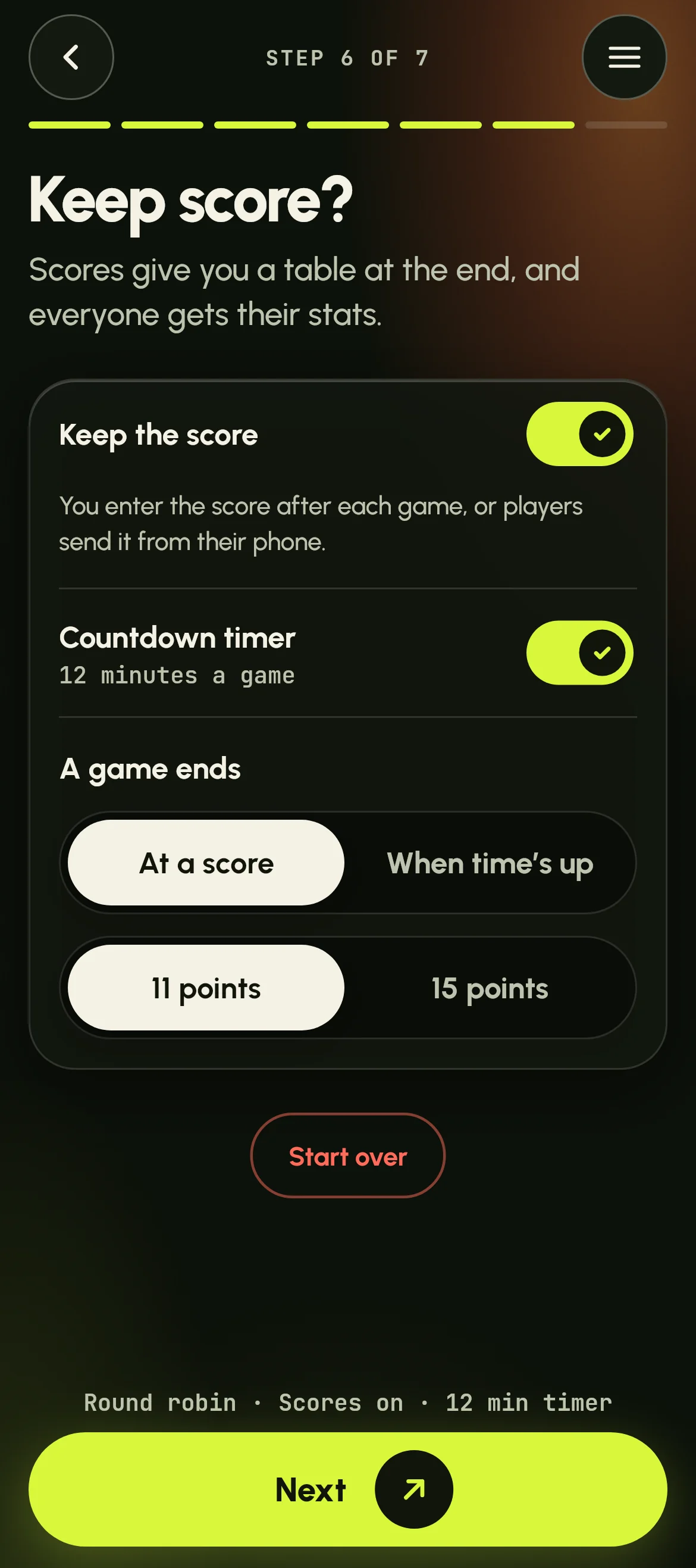
Keep score
Up-and-down needs the score of every game, so keeping score is always on. Choose games to 11 or 15 points.
-
Start the session
Tap Start session. Round 1 shows who plays on which court and who waits, and players see their own court on their phone.
-
Enter scores and play on
Enter each court's score when its game ends, then start the next round. Dink Duty moves the winners up and the losers down, with new partners. Add or remove players at any time.
More guides
Other ways to play, and running the night
-
Round robin
A new partner every round. Everyone plays with everyone.
-
Fixed partners
Keep the same partner all session. Pairs play other pairs.
-
Apex
Everyone's re-ranked after every round, so the stronger players rise to court 1 fast.
-
Running the night
From the QR code to sharing the results: scores, late arrivals and early leavers on the night.

Thursday's session, sorted.
Open Dink Duty on your phone

Point your phone's camera at the code, then tap the link that appears.