
Guide
The stronger players rise to court 1
Want a pickleball format where the stronger players end up on court 1, without fixed courts? After every round, everyone is re-ranked on their whole-night record and the courts are refilled from the top down, so players of similar level end up on the same courts. It's a skill-based rotation that copes with more players than courts, late arrivals and early leavers. In Dink Duty this format is called Apex.
What is Apex?
Apex is a doubles format for social play where the courts sort themselves by level. After every round, Dink Duty ranks everyone on their whole-session record and refills the courts from the top down: the top four on court 1, the next four on court 2, and so on.
Partners rotate every round, and nobody is knocked out. A good round can lift you more than one court at once, so within a few rounds the strongest players meet on court 1, and everyone else finds a court that suits them.
Apex is Dink Duty's own format, beside Round robin, Up-and-down and Fixed partners.
How is it different from up-and-down?
In up-and-down the river, each court's winners move up one court and its losers move down one. Climbing from the bottom court to the top takes a win every round, one court at a time.
In Apex, everyone is re-ranked on every game they have played so far, not just the last one. A player who starts too low can jump more than one court in a single round.
Pick up-and-down for a rule everyone can follow on court. Pick Apex when you want the courts sorted by level quickly.
Round 1 and the ranking
Round 1 is seeded by Dink Rating: the four highest rated on court 1, the next four on court 2, and so on down. Players with no rating yet count as the middle of the group. The organiser can pick a random first round instead.
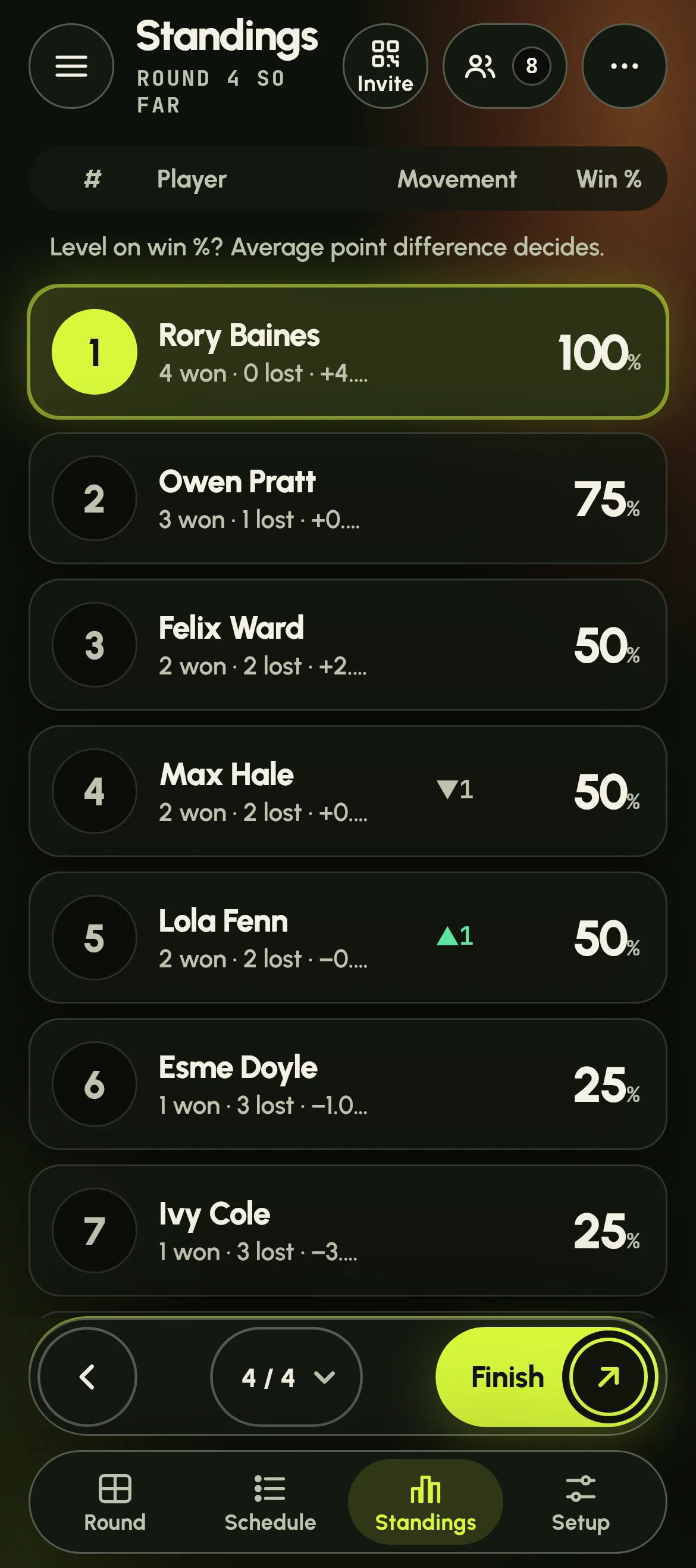
After every round, everyone is ranked on all their games so far:
- Win %: wins, plus half for each draw, divided by games played. A timed game that's level when time's up is a draw.
- Then average point difference: points won minus points lost, per game.
- Then Dink Rating, with unrated players counted as the middle of the group.
- Then at random.
The top four go on court 1, the next four on court 2, and so on. A winner tapped with no score is a win with no point difference, and a game with no result when the next round starts counts as a 0-0 draw.
Who partners whom
Four players on a court can split into pairs three ways. Dink Duty picks the split that repeats the fewest partners: first anyone who partnered last round, then partners from earlier in the session, then opponents.
If that still leaves a choice, it picks the closest match: the court's first and fourth ranked players against its second and third.
A worked example: 12 players on 3 courts
Alex, Bri, Cam, Dev, Eli, Fran, Gus, Hana, Ivy, Jack, Kai and Mia are rated in that order. Mia's Dink Rating is the lowest, but tonight she plays like the best player there. The scores are made up; the courts and rankings are what Dink Duty did with them.
-
Round 1: seeded by rating
Alex, Bri, Cam and Dev, the four highest rated, start on court 1, and Ivy, Jack, Kai and Mia on court 3. On court 1, Alex and Dev play Bri and Cam: first and fourth against second and third.
-
After round 1
Bri and Cam win court 1 11-9, Fran and Gus win court 2 11-9, and Ivy and Mia win court 3 11-3. Six players are on 100%, so point difference sorts them: Ivy and Mia, on +8, go top, above the other winners on +2.
-
Round 2: court 3 to court 1
Ivy and Mia go straight up two courts, to court 1 with Bri and Cam. Ivy and Mia have just partnered, so it's Ivy and Cam against Mia and Bri. Alex and Dev drop to court 2, and Eli and Hana to court 3.
-
After 4 rounds
Mia finishes first: 3 wins from 4 (75%) and +18 points, 4.5 a game. Alex (3.75 a game) and Bri (2 a game) also won 3 of 4, so point difference puts them second and third, and Gus, on 75% with 0.75 a game, fourth.
Sit-outs, late arrivals and leavers
When the players don't fill the courts in fours, the rest sit out that round. Dink Duty uses as many courts as the players fill, never more than you chose.
- Whoever has sat out least sits out next, and among them whoever sat out longest ago. Rank never decides who sits out, so the top players sit out as often as everyone else. In round 1 it's drawn at random.
- Sitting out doesn't hurt your standing: win % counts only the games you played. When you're back, you go to the court your rank earns.
- A late arrival starts on 50% with no point difference, so their Dink Rating places them among the players in the middle. After their first game they're ranked like everyone else.
- Someone who leaves early keeps their record and stays in the standings, marked Left.
The final standings
The final standings use the same ranking. To take a top-3 place, a player needs to have played at least half the rounds. Anyone who hasn't is listed below everyone who has, marked Not enough games.
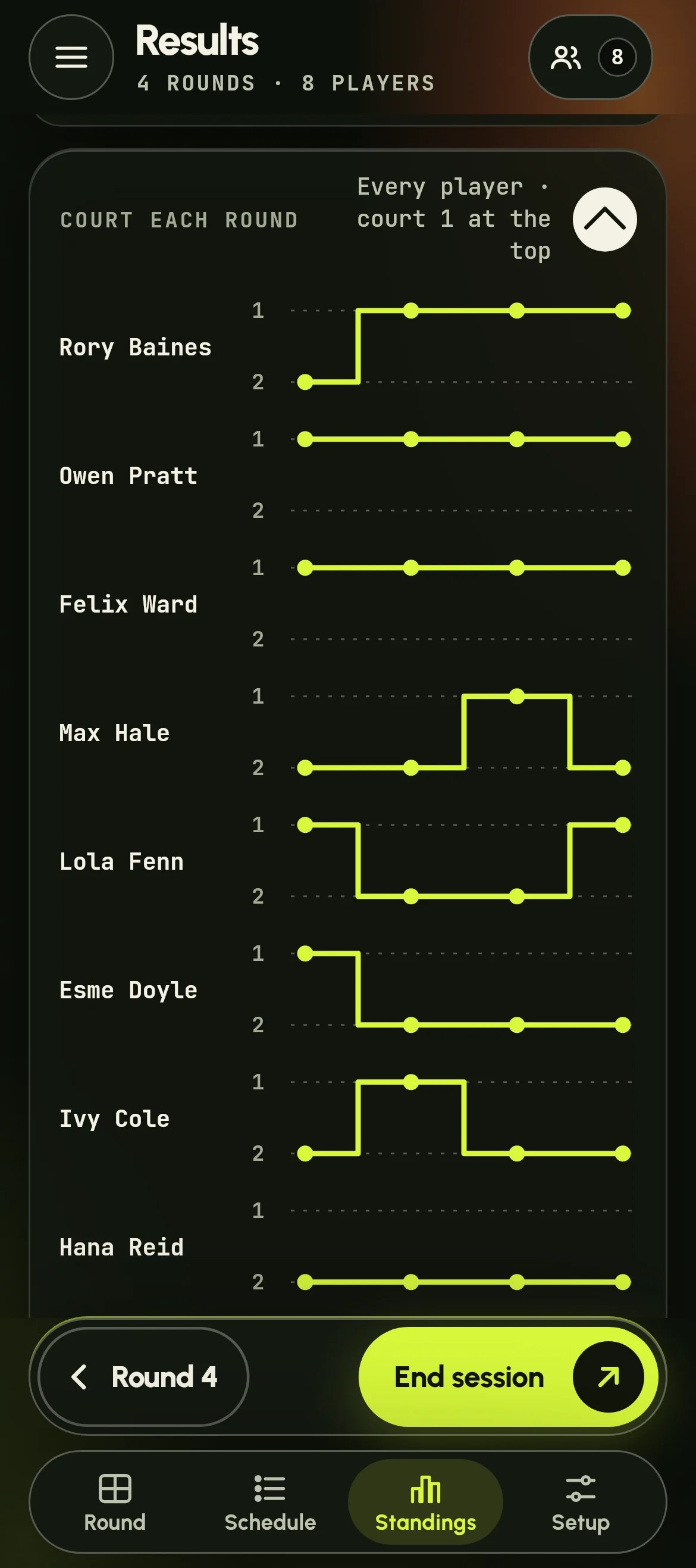
The results also show each player's court in every round, with court 1 at the top, so everyone can see how they rose or fell.
What Apex needs
Apex has a few limits, because each round is built from the last one's results:
- Doubles only, with a new partner every round.
- At least 8 players, enough for two full courts.
- Every game needs a result, so keeping score stays on. A game with no result when the next round starts counts as a 0-0 draw.
- Games are timed by default, so every court finishes together. You can play games to 11 or 15 points instead, but then courts may wait for the slowest game.
- Each round is built when the one before it ends, so the schedule shows only the rounds reached so far. The format can be changed until the first score.
In Dink Duty
How to set up Apex in Dink Duty
Dink Duty plans every round on the organiser's phone. Open it at app.dinkduty.com and follow its setup:
-
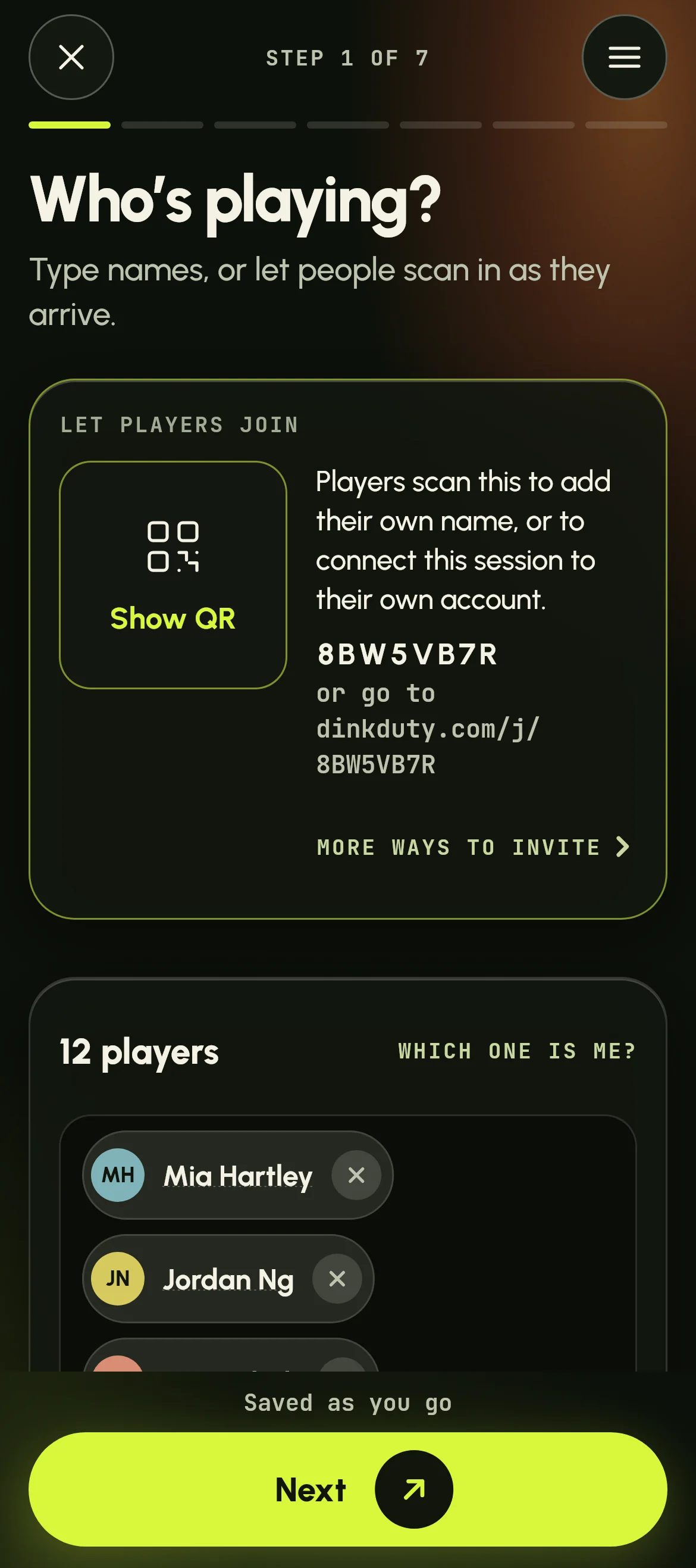
Add players
Type names in or paste a list, or show the QR code so players scan in and add their own. Apex needs at least 8.
-
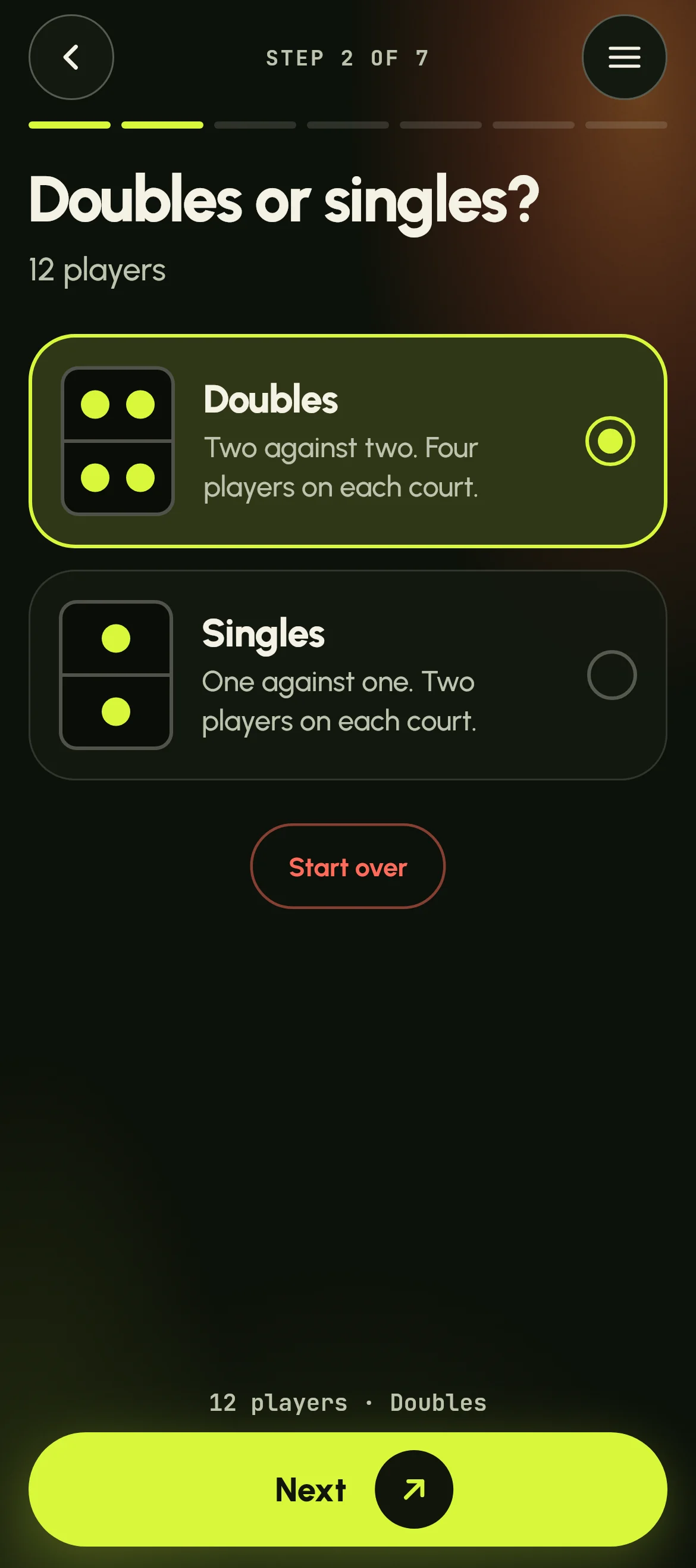
Pick doubles
Apex is doubles: two against two, four players on each court.
-
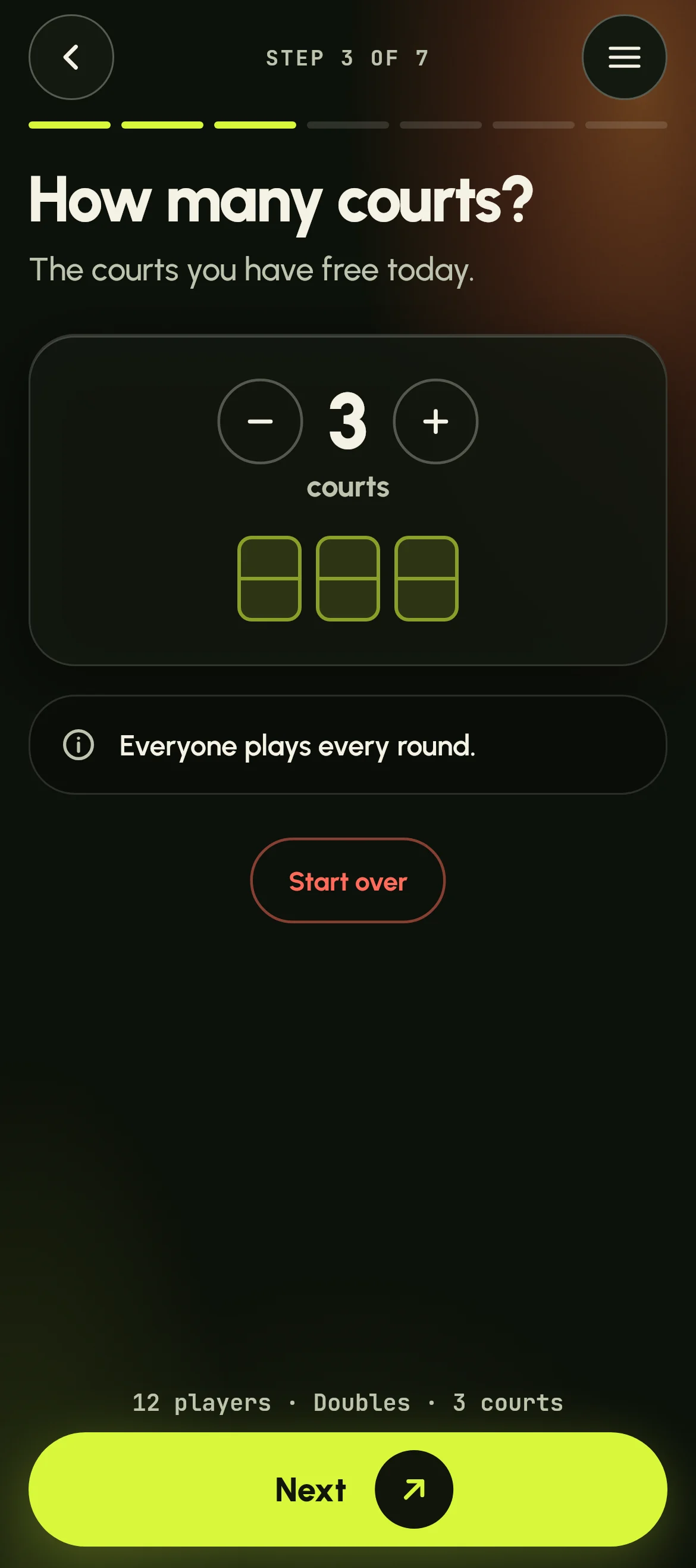
Set your courts
Choose the courts you have free today. Dink Duty shows how many people sit out each round.
-
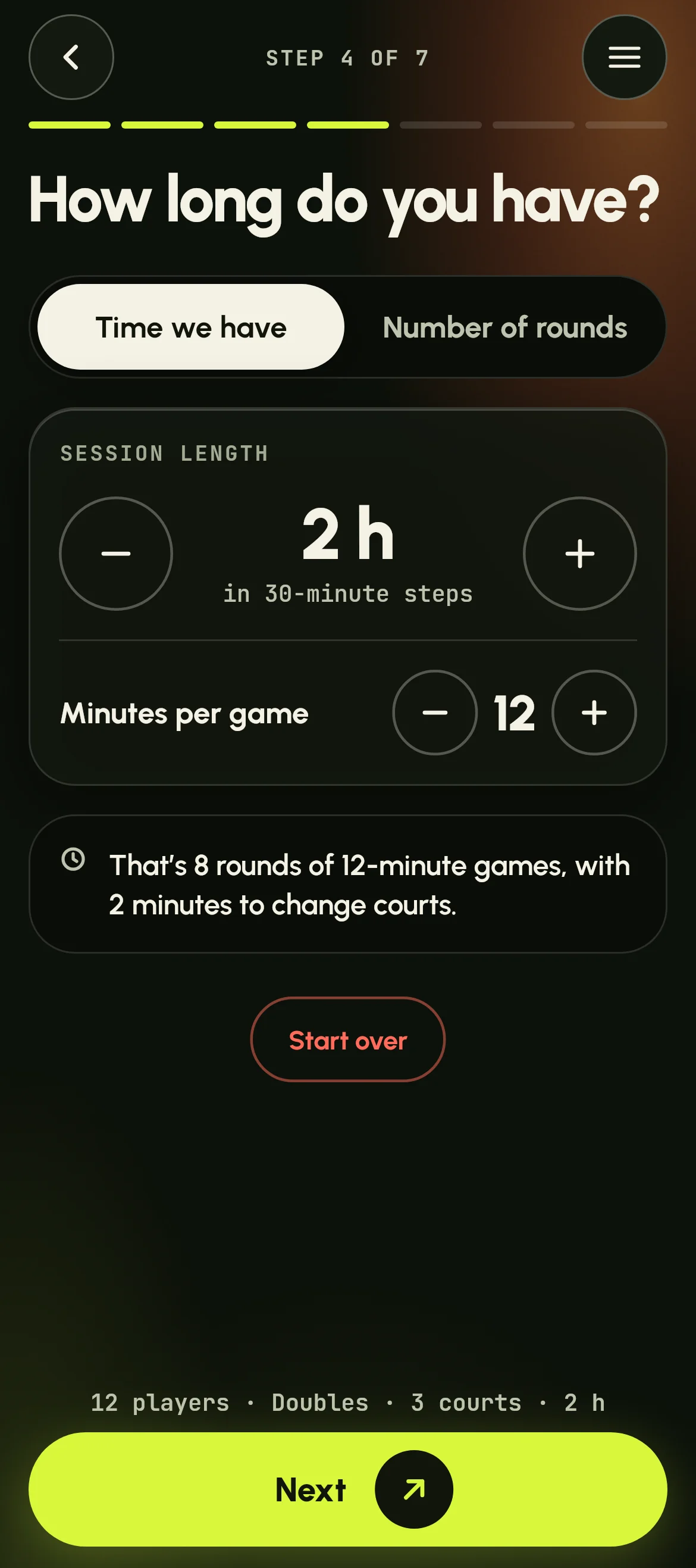
Choose how long
Enter the time you have and the minutes per game, or a number of rounds.
-
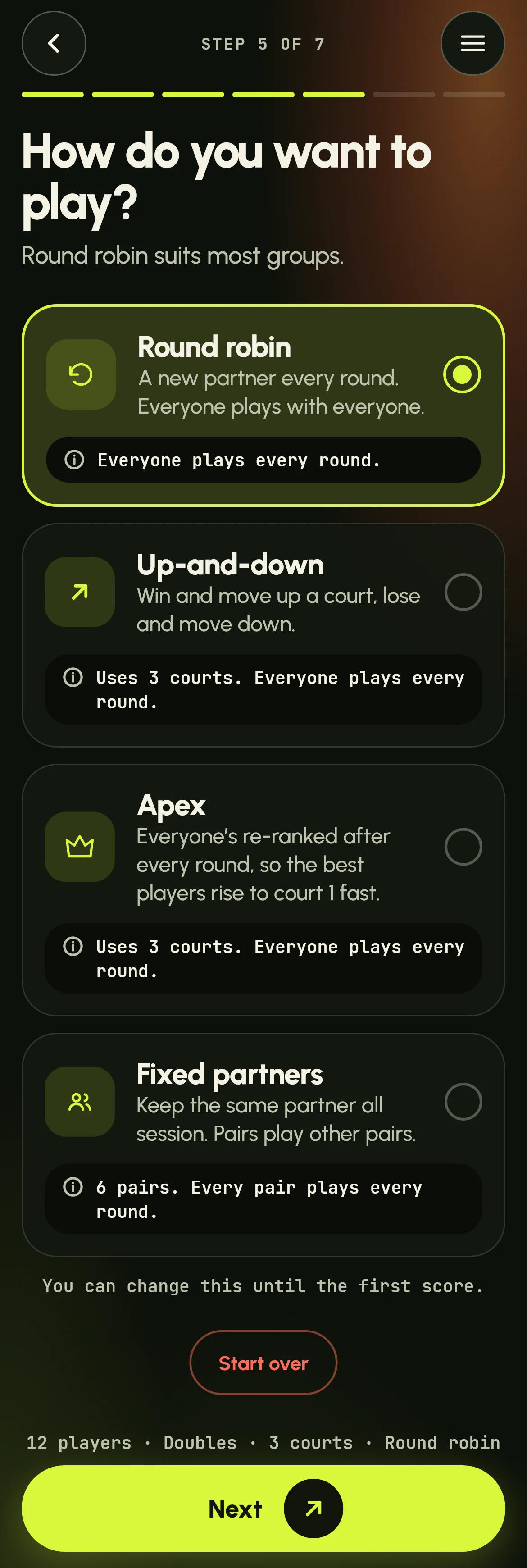
Pick Apex
Everyone's re-ranked after every round, so the stronger players rise to court 1 fast. Picking Apex switches on timed games and works out the rounds from your time.
-
Keep score
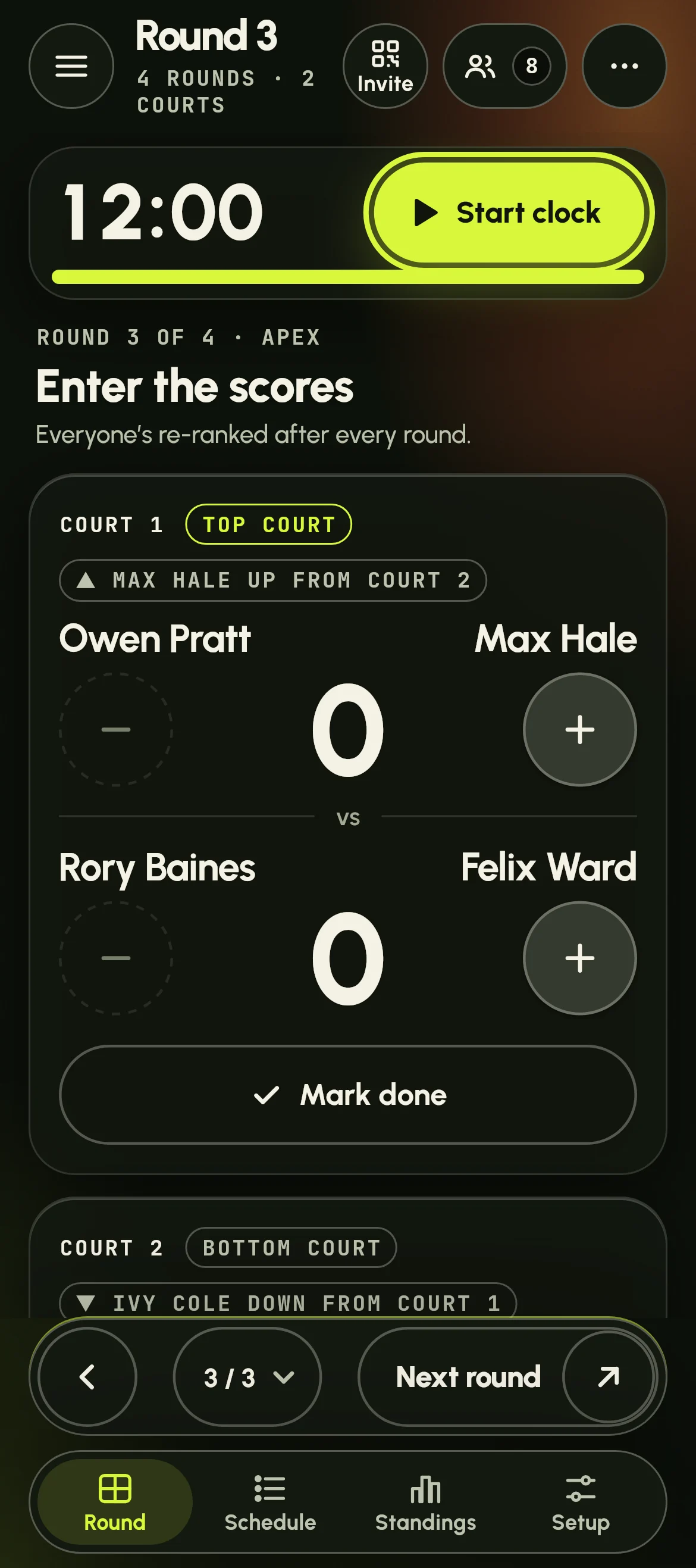
Apex is built from results, so the score is always on. Enter it after each game, or players send it from their phone. Games end when time's up.
-
Play the rounds
Tap Start session. After each round, tap Next round: everyone is re-ranked and the courts are refilled from court 1 down. Add or remove players at any time.
-
Finish
Tap Finish after the last round. The results show the final standings and each player's court in every round.
More guides
Other ways to play, and running the night
-
Round robin
A new partner every round. Everyone plays with everyone.
-
Fixed partners
Keep the same partner all session. Pairs play other pairs.
-
Up-and-down
Win and move up a court, lose and move down.
-
Running the night
From the QR code to sharing the results: scores, late arrivals and early leavers on the night.

Thursday's session, sorted.
Open Dink Duty on your phone

Point your phone's camera at the code, then tap the link that appears.