
Guide
How a pickleball round robin works
Everyone gets a new partner each round, and nobody is knocked out. How many rounds 8 players on 2 courts or 12 on 3 need, what to do with odd numbers, and a free app that plans it.
What is a round robin?
In a pickleball round robin, players change partners every round. Over the session everyone plays with, and against, as many different people as the rounds allow.
Nobody is knocked out: everyone plays to the end. Each court plays one game a round, four players in doubles and two in singles, and every court starts the next round together.
You can keep score for a table at the end, or just play. It's the usual format for social play, and the one Dink Duty suggests for most groups.
For a format where winners move up a court and losers move down, there's up and down the river, and Dink Duty runs that too.
Running the night itself, from the QR code to sharing the results, is in How to run a pickleball round robin.
How many rounds and games?
For everyone to partner everyone else once, a doubles round robin needs one round fewer than the number of players: 7 rounds for 8 players, 11 for 12. With an odd number of players it takes as many rounds as there are players: 9 rounds for 9. Dink Duty calls this a full rotation.
Each court plays one game a round. These are Dink Duty's schedules for common doubles groups:
-
8 players on 2 courts
A full rotation is 7 rounds. Everyone plays every round, 7 games each.
-
10 players on 2 courts
A full rotation is 9 rounds. 2 sit out each round, 7 or 8 games each.
With 8, 12 or 16 players on enough courts, everyone plays every round and partners each other player exactly once. With 9 or 13, one player sits out each round and everyone still partners everyone once.
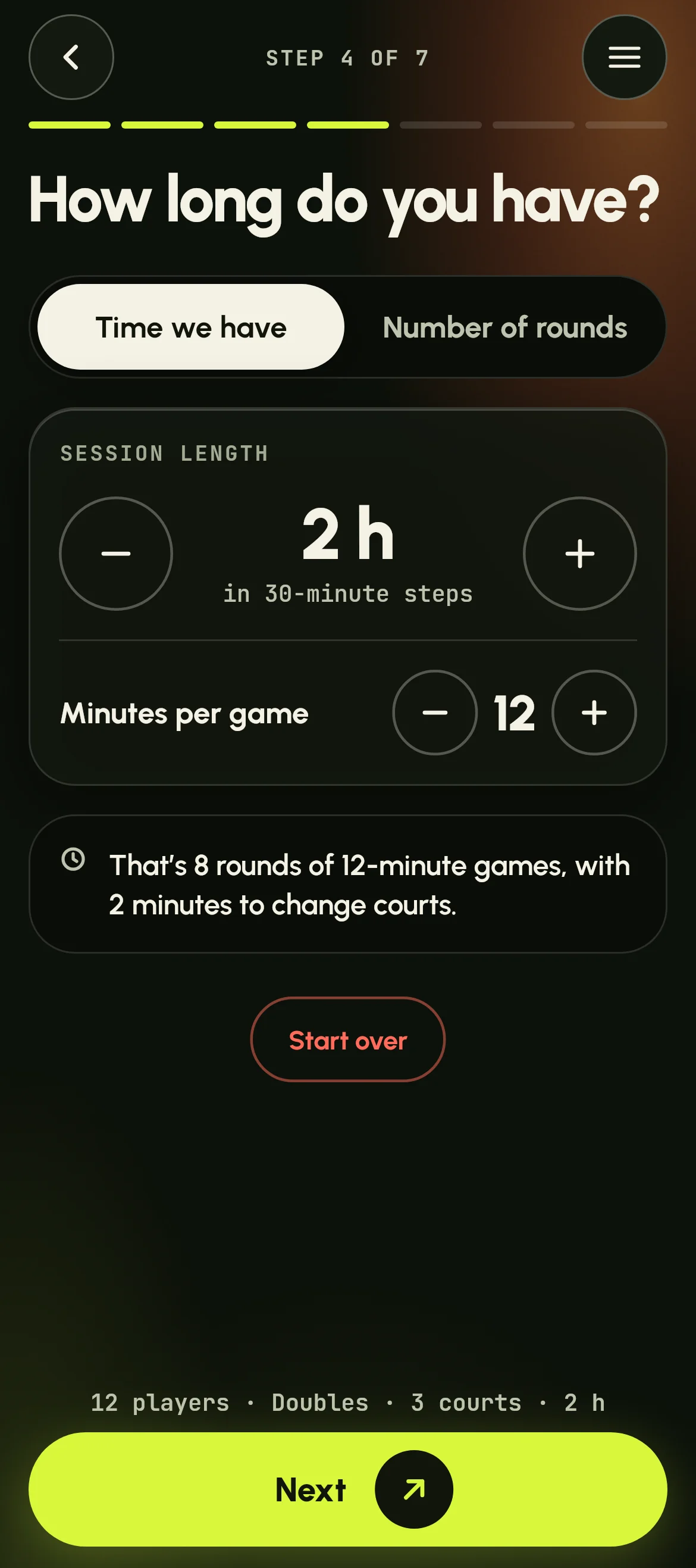
A full rotation is often longer than the session, so most groups play to the time they have. Dink Duty's time planner divides the time by the game length plus the changeover: two hours of 10-minute games with 2 minutes between them is 10 rounds. A session can have up to 20 rounds, on up to 8 courts.
Byes, sit-outs and odd numbers
When the players don't divide into fours, or there are more players than the courts hold, the rest sit out that round. In a round robin that's called a bye or a sit-out.
Dink Duty shares sit-outs fairly: nobody sits out a second time until everyone has sat out once, and among the rest, whoever sat out longest ago goes next.
- One spare player (5, 9, 13 or 17): one sits out each round, and over a full rotation everyone sits out once and partners everyone else once.
- Two or three spare players (10, 11, 14 or 15): two or three sit out each round. Their partners that round are paired with someone they've partnered least, so a few partnerships repeat.
- Fewer players than courts: Dink Duty uses only the courts it can fill. 10 players on 3 courts play 2 games a round, and 2 sit out.
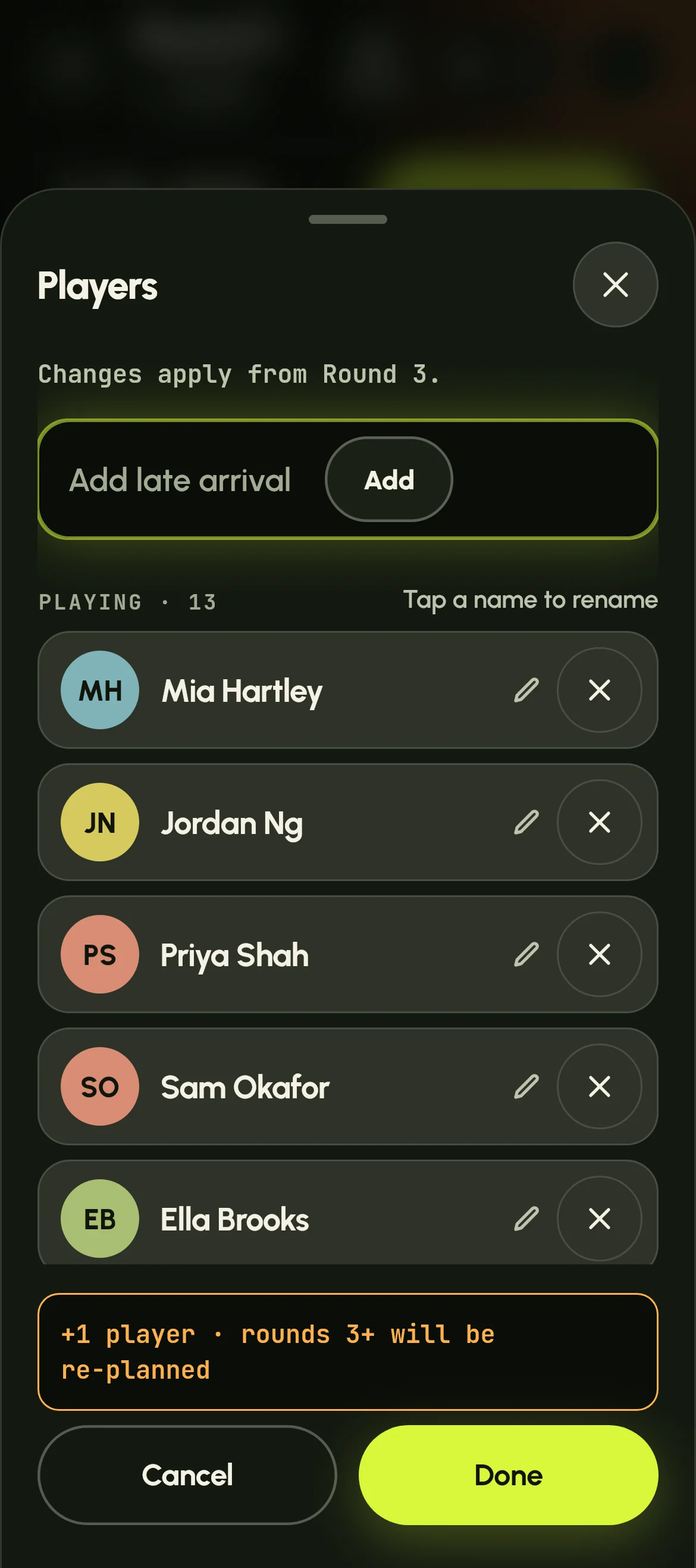
- Late arrivals and early leavers: add or remove them at any time. The rounds already played stay as they were, and the rest are planned again. A missed round counts as a sit-out, so a late arrival isn't first in line to sit out.
- Doubles needs at least 4 players, and singles at least 2.
Fixed partners
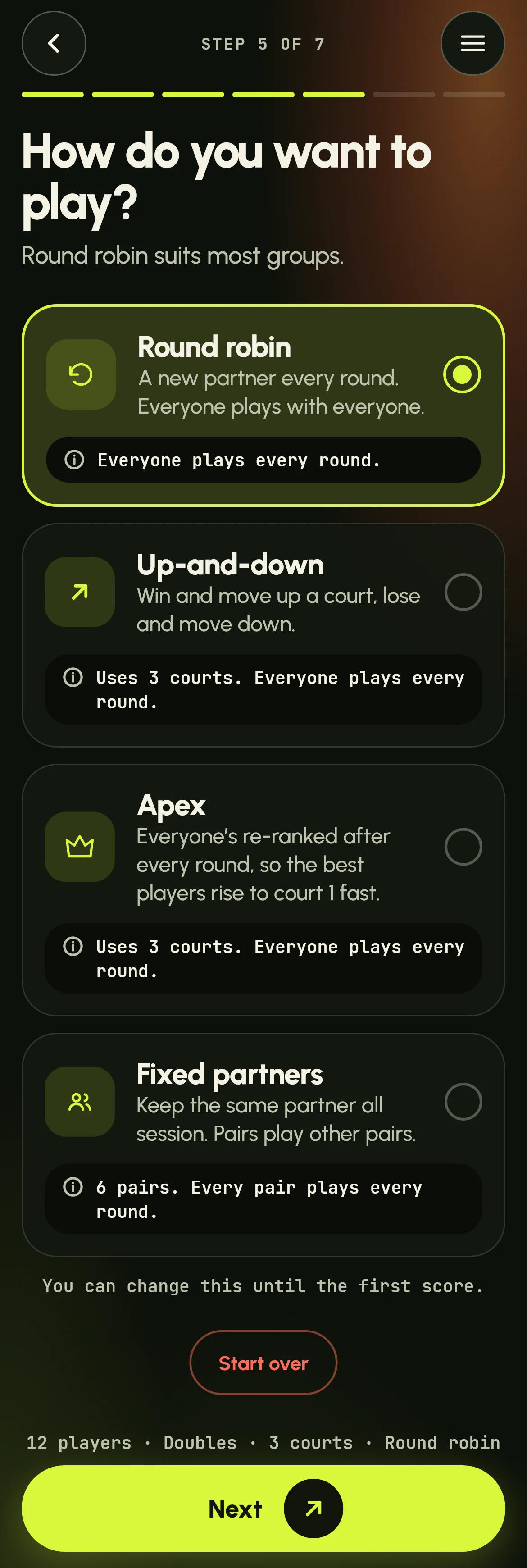
In a fixed-partners round robin, each pair keeps the same partner all session and plays the other pairs. It's doubles only, and every player needs a partner, so it takes an even number of players.
For every pair to play every other pair once takes one round fewer than the number of pairs, or as many rounds as pairs when that number is odd. For example:
-
8 players on 2 courts
4 pairs. 3 rounds for every pair to play every other pair once. Every pair plays every round, 3 games each.
-
10 players on 2 courts
5 pairs. 5 rounds for every pair to play every other pair once. 1 pair sits out each round, 4 games each.
Those are short, so most sessions go round again. Dink Duty plans the extra rounds so the fewest match-ups repeat, and shares sit-outs between pairs the same way it does between players.
Dink Duty pairs people of a similar level by their Dink Rating. Tap two names to swap them, or type a pair together, like Alex & Bri, to keep them together.
With an odd number, someone has no partner, and Dink Duty won't start until everyone has one. During the session, players who arrive on their own wait, and the next one to arrive becomes their partner.
In Dink Duty
How to set up a round robin in Dink Duty
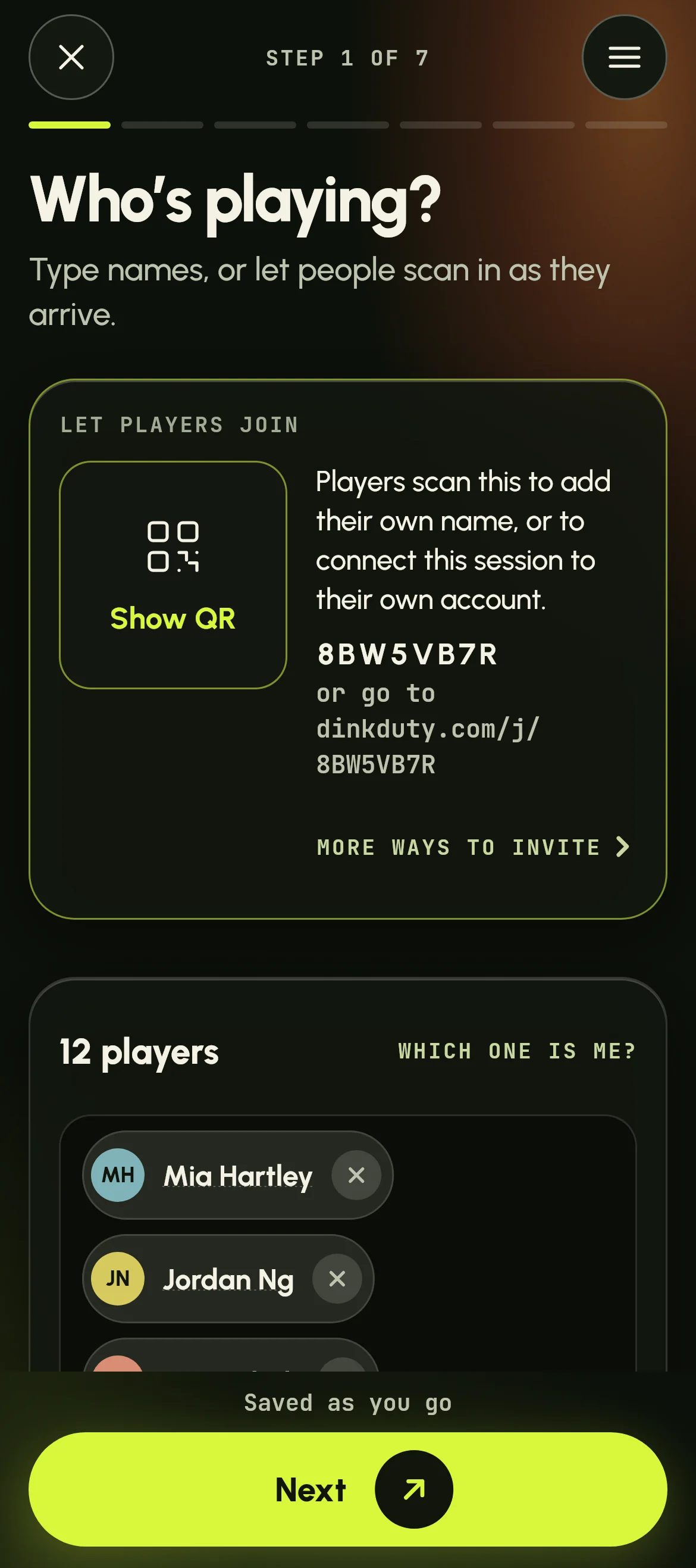
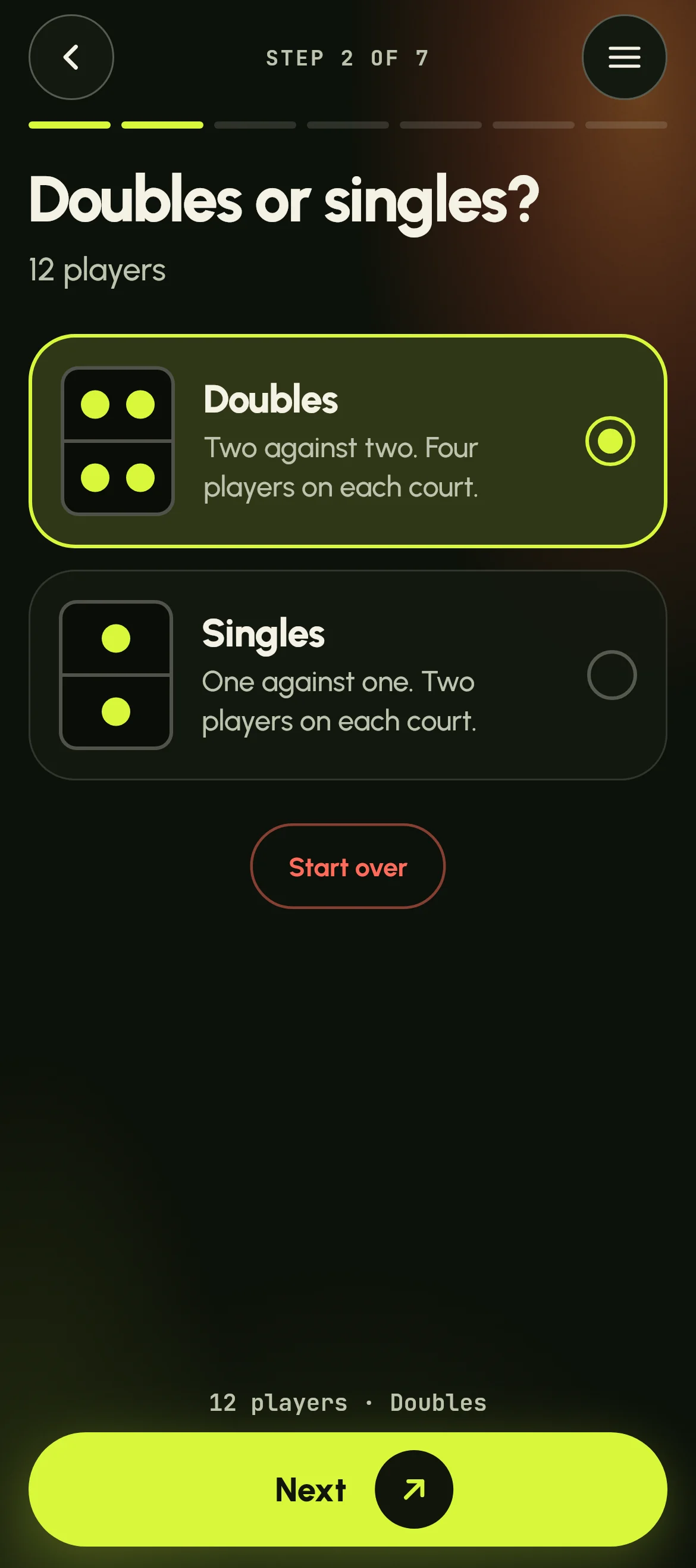
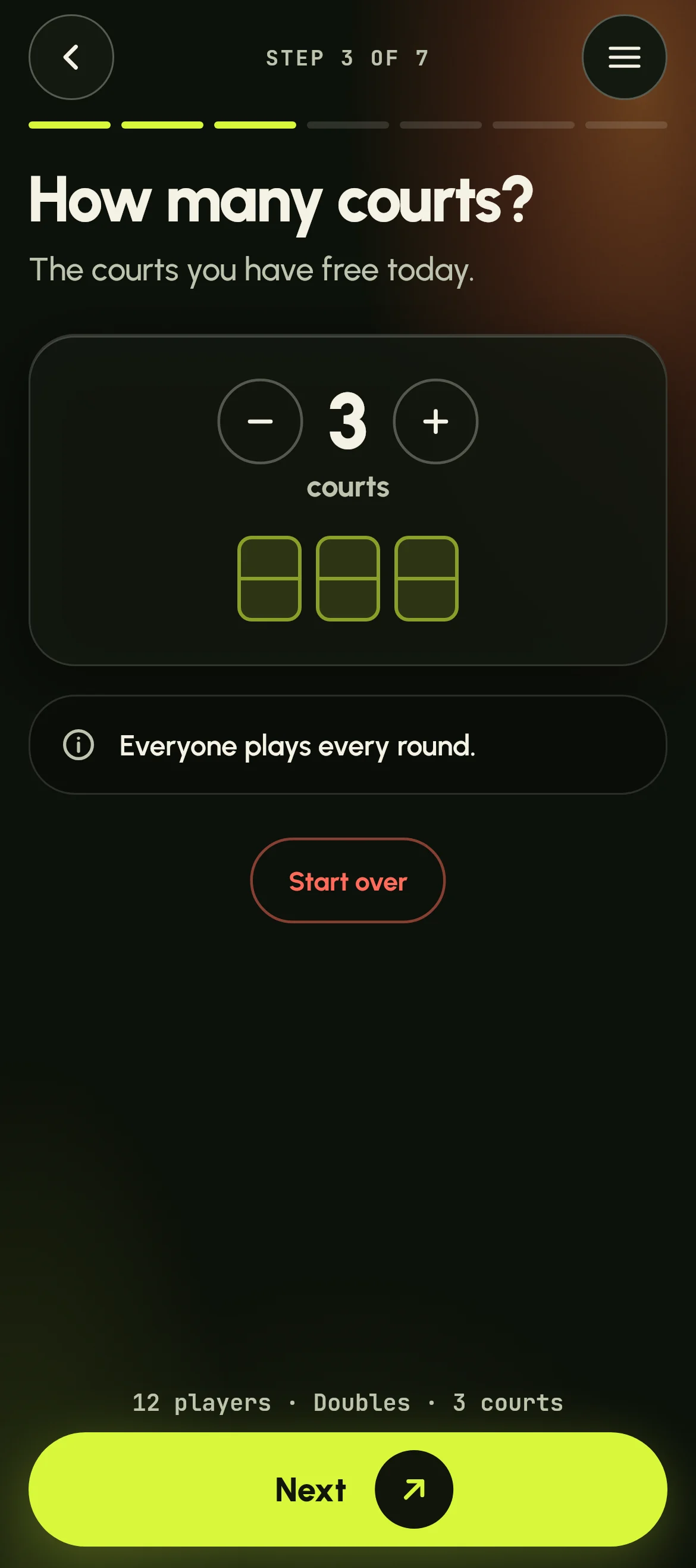
Dink Duty plans every round on the organiser's phone. Open it at app.dinkduty.com and follow its setup:
-
Add players
Type names in or paste a list, or show the QR code so players scan in and add their own.
-
Pick doubles or singles
Doubles is two against two, four players on each court. Singles is one against one.
-
Set your courts
Choose the courts you have free today. Dink Duty shows how many people sit out each round.
-
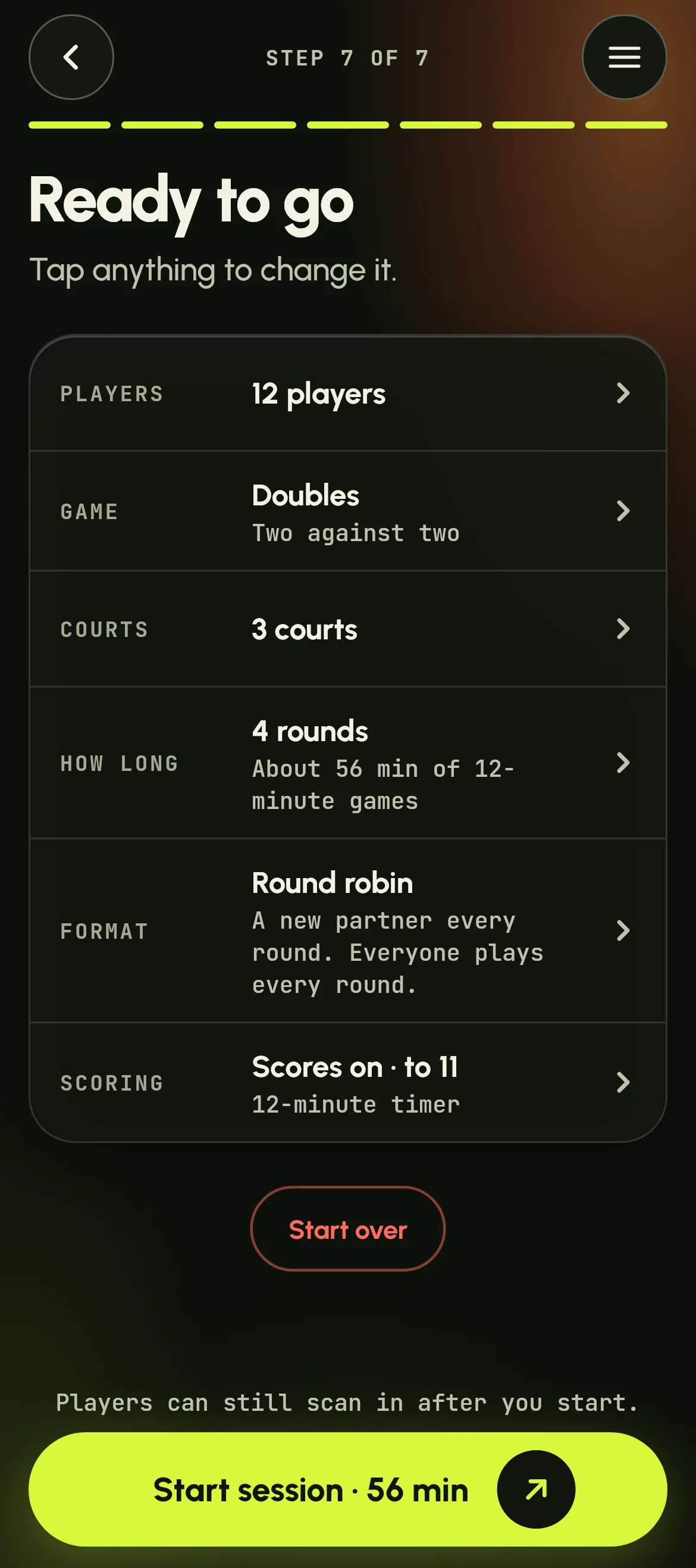
Choose how long
Enter the time you have and the minutes per game, or a number of rounds.
-
Pick Round robin
Round robin gives everyone a new partner every round. Pick Fixed partners instead to keep the same partner all session.
-
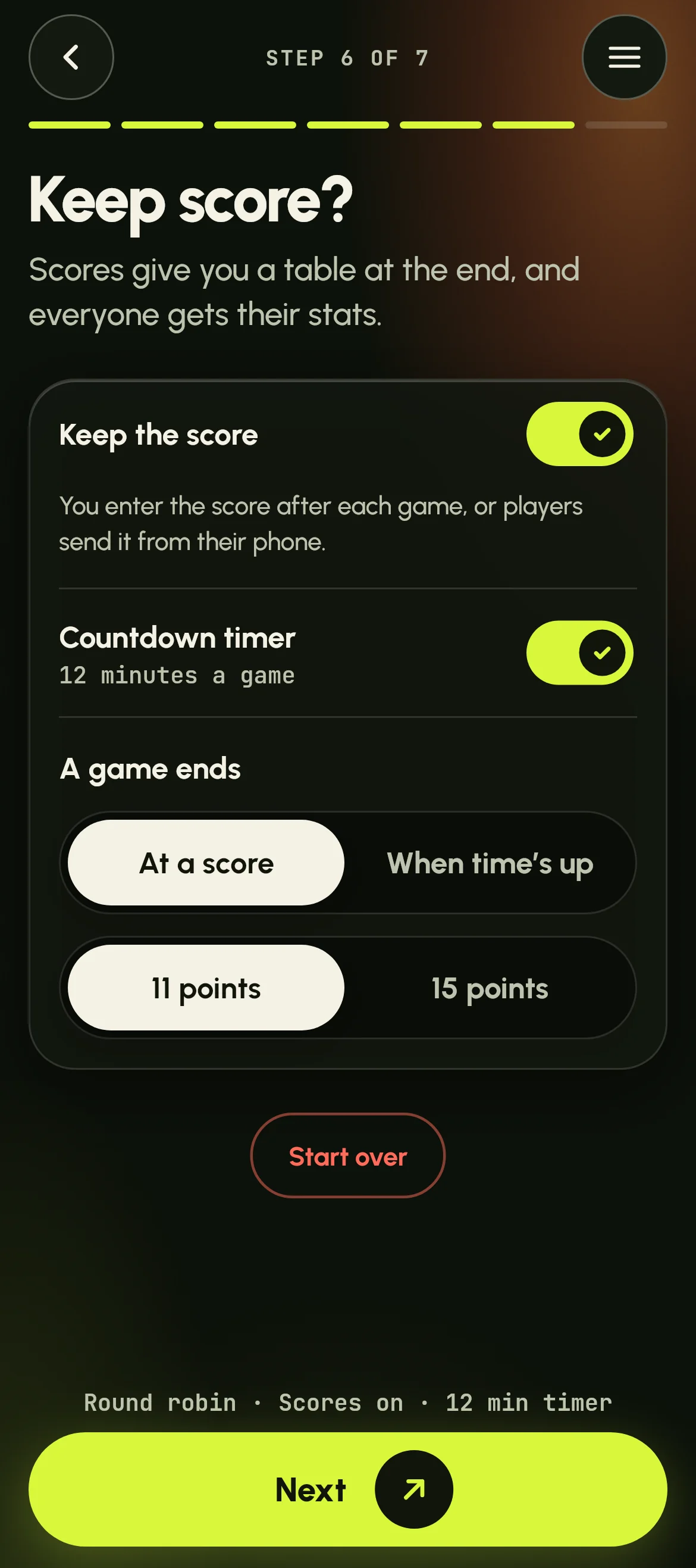
Keep score, or just play
Scores give you a table at the end, and everyone gets their stats.
-
Start the session
Tap Start session. Each round shows who plays on which court and who sits out, and players see their own court on their phone.
-
Play the rounds
When a round's games are done, start the next. Add or remove players at any time, and the rounds still to come are planned again.
More guides
Other ways to play, and running the night
-
Up-and-down
Win and move up a court, lose and move down.
-
Apex
Everyone's re-ranked after every round, so the stronger players rise to court 1 fast.
-
Running the night
From the QR code to sharing the results: scores, late arrivals and early leavers on the night.

Thursday's session, sorted.
Open Dink Duty on your phone

Point your phone's camera at the code, then tap the link that appears.